
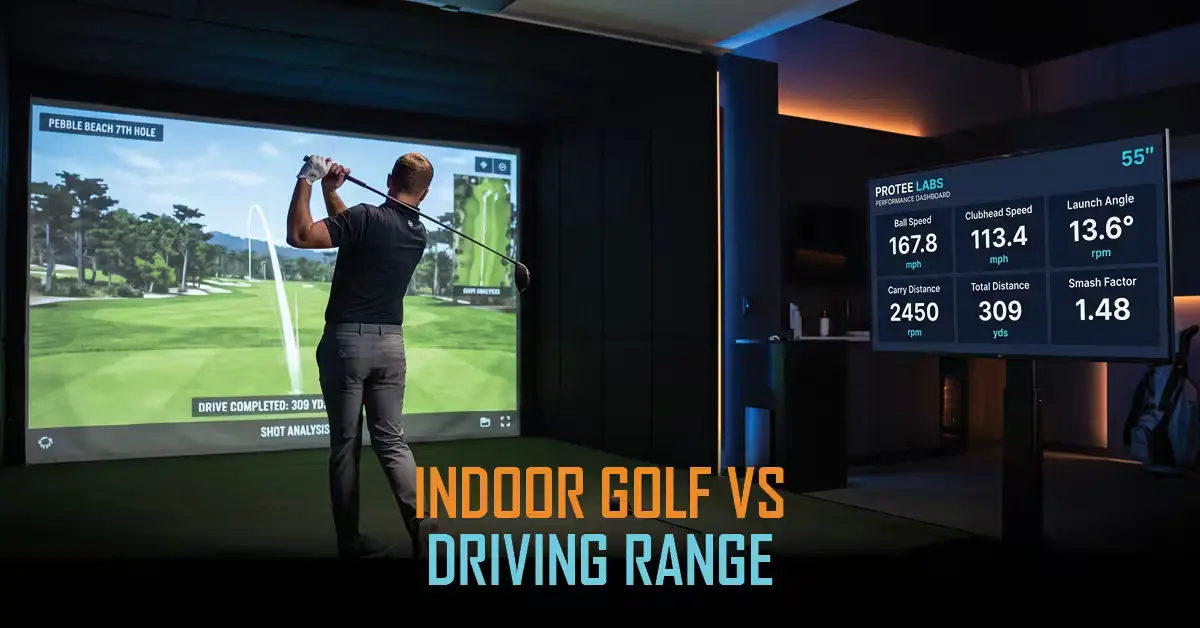
Indoor golf is better for improving your game. A driving range is useful for warming up and hitting volume. At The Bay, the difference came into sharp focus when our co-founder Mat Barnes discovered his real carry distances and realised he had been selecting the wrong club for years.
This is an honest comparison. We will tell you when a driving range makes sense and when a simulator gives you something a mat and a bucket of balls never can.
What You Get from Each Session
The fundamental difference is feedback. A basic driving range shows you ball flight. You see whether it went left, right, high, or low. That is all the information you get.
A simulator session at The Bay gives you the data behind the flight. Launch angle, ball speed, club path, spin rate, and carry distance on every single shot. That is a different category of practice entirely.
Repetition without data builds habits. Repetition with data builds understanding.
The Carry Distance Problem
When Mat Barnes first used the ProTee VX at The Bay, the data told a different story to the one he had in his head. His consistent carry distances were significantly shorter than he had assumed. He had been making club selections based on his best shots, not his real shots.
That single correction contributed directly to a 9-stroke improvement in his handicap over 7 months. A basic driving range would not have shown him this. There is no carry data on a basic range. You see where the ball lands on a mat and decide for yourself what it means.
What a Basic Driving Range Cannot Show You
A basic driving range mat is flat, uniform, and without context. You hit a ball, it flies, you hit another. There is no carry verification, no spin data, and no course conditions to respond to.
This is how the driving range reinforces the wrong habits. If you are consistently coming over the top on your downswing, a bucket of balls will not tell you. A thousand repetitions of the same fault builds confidence in the wrong pattern.
At The Bay, the ProTee VX shows you club path data on every shot. If there is a pattern, you see it immediately. That is what changes behaviour.
Playing Actual Golf vs Hitting Balls
There is a difference between hitting balls and playing golf. A driving range is hitting balls. A simulator session at The Bay is playing golf.
You select clubs for real distances and lies. You experience the pressure of a par-three over water. GSpro gives you access to a large course library, with courses playing under altered names.
That course context makes every shot decision meaningful in a way that a flat driving range mat never can.
The Time and Value Comparison
Both options take a similar block of time. The difference is what you walk away with.
Practice format Driving range: a bucket of balls, 45-60 minutes. The Bay: 18 holes on a real course, under 2 hours.
Feedback Basic driving range: visual flight only. The Bay: full ProTee VX data on every shot.
Carry distance verification Basic driving range: none. The Bay: real carry data per club, every session.
Course context Driving range: flat mat, no context. The Bay: a large course library via GSpro.
Food and drinks Driving range: venue cafe or bring your own. The Bay: delivered to your bench by our Hosts, you never leave your bay.
Weather Driving range: outdoor, weather-dependent. The Bay: climate-controlled year-round.
Which Is Actually Better?
For warming up before a round, a driving range does the job. For improving your game, a simulator gives you what a driving range cannot.
The honest answer depends on what you are trying to do. If you want to hit balls and feel loose, a driving range works. If you want to know what your swing is actually doing and why, you need data.
At The Bay, we see the same pattern with new players consistently. They arrive with assumptions about their carry distances. The ProTee VX corrects those assumptions in the first session. That is when the improvement starts. For more on how that improvement translates to real game results, read do golf simulators actually improve your real game.
For the full picture on indoor golf options in Sydney, see our complete guide to indoor golf and golf simulators in Sydney.
Frequently Asked Questions
Are golf simulators worth it?
Yes, particularly if improvement is your goal. A simulator gives you full swing data on every shot, including the carry distance, club path, and launch angle that a basic driving range cannot provide. At The Bay, that data comes from our ProTee VX launch monitor in real time, every session.
Is a golf simulator a good way to practice?
Yes. A simulator is one of the most efficient ways to practice because every shot produces actionable data. At The Bay, you play 18 holes of a real course in under two hours, with full ProTee VX feedback on every shot. That is a more complete practice session than a bucket of balls on a mat.
How accurate is a golf simulator compared to real golf?
The ProTee VX at The Bay measures every shot, including spin rate, launch angle, club path, and ball speed. Darren spent two years testing simulator systems before choosing it.
Is indoor golf expensive?
Indoor golf at The Bay is priced per bay, not per player. Split across a group of up to six, the per-person cost drops. Four players for two hours pay $138 for the bay, about $34.50 each, before food and drinks. That was the rate on 6 October 2026, so check the pricing page for current rates. For the full breakdown, read how much does indoor golf cost in Sydney.