
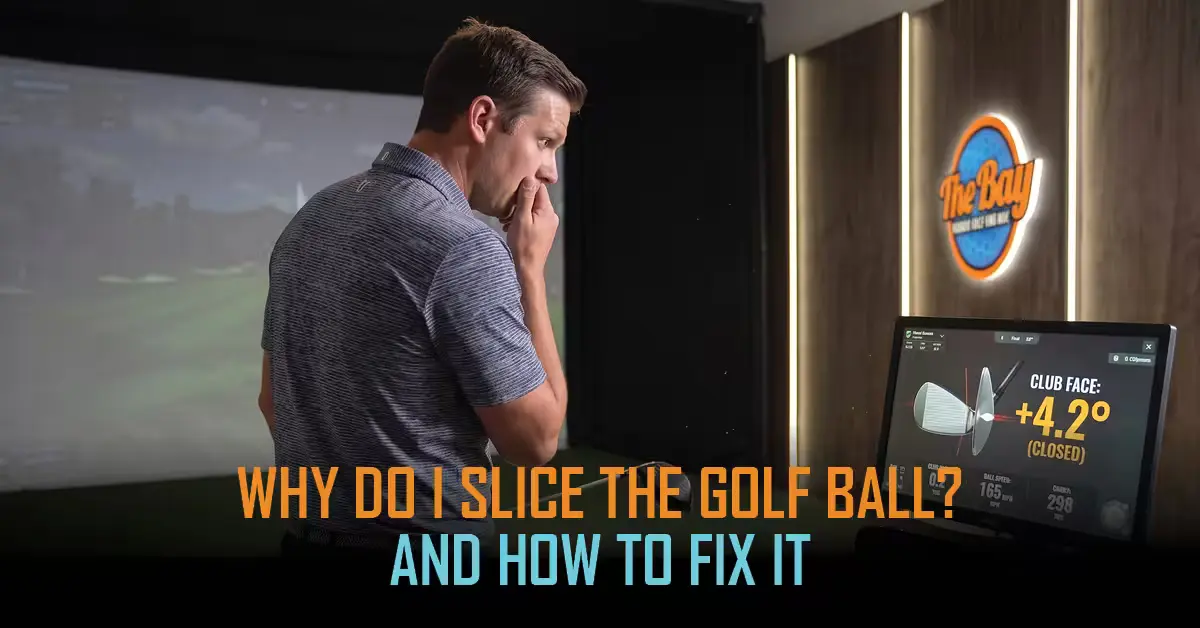
A slice happens because your club face is open at impact and your swing path travels from outside to inside across the ball. Those two things combine to put right-curving sidespin on the ball, and the result is the banana-shaped flight that plagues almost every golfer who has ever picked up a club.
At The Bay, the ProTee VX measures your club face angle and swing path on every shot, which means you can see what is causing your slice in the data and watch those numbers change as you apply the fixes.
There are three corrections that work for most slicers. All three can be practised at The Bay, and the data shows whether they are taking effect.
What Is Actually Happening When You Slice
Think about what happens when you swipe a tennis racquet or a ping-pong paddle sideways across the ball. The sideways contact puts spin on the ball that curves it hard in one direction. Your golf club is doing the same thing, just with two problems happening at once.
The first problem is your club face. At the moment of impact, your club face is open: it is pointing to the right of where you are swinging. An open face applies right-curving sidespin to every shot, regardless of where your swing is going.
The second problem is your swing path. Most slicers swing from outside to inside: the club comes down on a line that starts outside the ball’s target line and cuts across it from right to left at impact. This outside-in path amplifies the sidespin from the open face and produces the curved, weakened flight that robs you of distance and sends the ball into trouble.
On the ProTee VX at The Bay, these two numbers appear after every single shot. Club face angle tells you how open or closed the face was at impact. Club path tells you whether your swing was inside-out, outside-in, or straight through the ball. A slicer’s data typically shows a face angle of three to eight degrees open and a club path of three to six degrees outside-in. You do not need to guess at what is causing your slice. The numbers show you.
Fix One: The 3-Knuckle Grip
The grip is the only connection between your body and the club, and it controls what the face does through impact. Most slicers hold the club with a weak grip: their lead hand (the left hand for a right-handed golfer) is rotated too far to the left on the handle, which means the face stays open through the swing and cannot square up at impact no matter what the rest of the body does.
The fix is to strengthen your grip. Look down at your lead hand on the club. Count the knuckles you can see from your address position. If you can only see one, your grip is weak. You want to rotate your hand slightly to the right until you can clearly see two to three knuckles. That rotation closes the face angle slightly at address and allows the club to release naturally through impact rather than staying open.
The grip adjustment feels strange at first. Most golfers who have been slicing for a while have trained their hands into the wrong position and the correct position feels uncomfortable for a few sessions. Stick with it. The ProTee VX face angle data will show you the effect: the open face reading should reduce as the grip strengthens and the club begins to square through impact.
Fix Two: Swing to Right Field
Most slicers know their ball is curving right, so their instinct is to aim further left to compensate. This makes the problem worse. Aiming left encourages an even more aggressive outside-in path, which adds more sidespin, which produces a bigger curve. You end up aiming further and further left while the ball curves further and further right.
The fix is to change the direction your swing is travelling, not where you are aiming. Think about a baseball swing. When you hit to right field in baseball, you swing the bat down and out toward right field, pushing the bat away from your body through the hitting zone. Apply the same image to your golf swing. Instead of chopping across the ball from right to left, try to swing the club down and out through the ball toward right field.
This image retrains the swing path from outside-in to inside-out. You are no longer cutting across the ball. You are pushing through it. The sidespin reduces, the face has more time to square, and the ball starts to fly straighter and further.
On the ProTee VX, the club path number shows this. An outside-in path shows as a negative number. As the swing path shifts toward inside-out, that number moves toward zero, then into positive territory. You can see the fix working in the data while you feel it in the swing.
Fix Three: The Headcover Trap Drill
Understanding a swing change intellectually and making it happen in an actual swing are two different things. The headcover trap is a drill that physically forces your swing onto the correct path without you having to think about it.
Place your driver headcover on the ground a few inches behind and slightly outside your ball. Set up and swing normally. If your old outside-in path is still active, your club will strike the headcover on the way down. To miss the headcover, your club is forced to approach the ball from the inside: the path changes because the obstacle demands it, not because you are consciously trying to change the swing.
At The Bay, this drill works directly on the bay mat and the ProTee VX records the result of every swing. You can alternate between headcover-in-place and no headcover and compare the club path data across the two versions. The drill shows you in the numbers whether the path is genuinely changing or whether you are adjusting address to miss the headcover while leaving the swing path unchanged. The data does not allow you to fool yourself.
Run the drill for a session until the inside-out path becomes the natural default. Then remove the headcover and check whether the path holds without the obstacle.
How the ProTee VX Shows You the Fix Working in Real Time
This is the part that makes fixing a slice at The Bay different from fixing it anywhere else.
On an outdoor driving range, you watch the ball flight and guess at whether the fix is working. The ball curves less, or it does not. You adjust your feel and try again. The feedback is slow, imprecise, and entirely dependent on your ability to read the ball flight accurately while also trying to feel a new swing.
At The Bay, you see the numbers after every shot. Club face angle. Club path. Ball speed. Spin rate. Flight path. You are not guessing at what changed. You are reading it.
Once you can see the number, you can track it session by session. Face angle and club path should move toward zero as the fix takes hold. The numbers can straighten out before the ball flight does, which keeps you working on the right things rather than abandoning a fix that is already working.
For golfers across Kirrawee, Caringbah, and the Sutherland Shire who have been fighting a slice for years, this is what a few sessions at The Bay can give you: a way of seeing your own swing clearly.
Your Slice Is Fixable
Almost every golfer slices at some point. Most of them keep slicing because they keep guessing at the cause and applying the wrong fix, or the right fix without the feedback to know it is working.
Open face. Outside-in path. Two problems, three fixes, and real-time data that shows you when the corrections take effect. Come into The Bay in Kirrawee, book a bay, and spend a session with the ProTee VX working on your club path and face angle.
For more on improving your game, read Do Golf Simulators Actually Improve Your Real Game?, How to Add Distance to Your Golf Drive: What the Data Shows, and the Complete Guide to Indoor Golf and Golf Simulators in Sydney.
Frequently Asked Questions
Why do I slice the golf ball?
A slice is caused by two things happening at the same time: an open club face at impact and an outside-in swing path. The open face applies right-curving sidespin to the ball. The outside-in path amplifies that spin and weakens the shot. On the ProTee VX at The Bay, both numbers, club face angle and club path, appear after every shot, so you can see what is causing your slice rather than guessing at it from the ball flight alone.
How do I stop slicing in golf?
The three most effective fixes for a slice are: strengthen your grip so the club face can square through impact (look for two to three knuckles on your lead hand); change your swing path from outside-in to inside-out using the right-field image; and use the headcover trap drill to physically retrain the path without conscious thought. The ProTee VX data at The Bay shows whether each fix is having an effect.
How do I improve my golf swing?
Improving your golf swing is faster when you can see what your swing is actually doing rather than guessing from ball flight. The ProTee VX at The Bay measures club face angle, club path, attack angle, ball speed, launch angle, spin rate, and a range of other data points on every shot. A session at The Bay tells you where your swing is now, which makes it possible to track genuine improvement over time rather than working on feel alone.
How do I hit a golf ball straighter?
A straight ball flight requires a square club face and a swing path that travels close to the target line through impact. The most common cause of a curved ball flight is an open or closed face combined with a path that cuts across the ball. Fixing the grip and the path, as described in this article, addresses both causes. The ProTee VX at The Bay shows you your face angle and path after every shot, so you can see in the data when both numbers are moving toward square.