
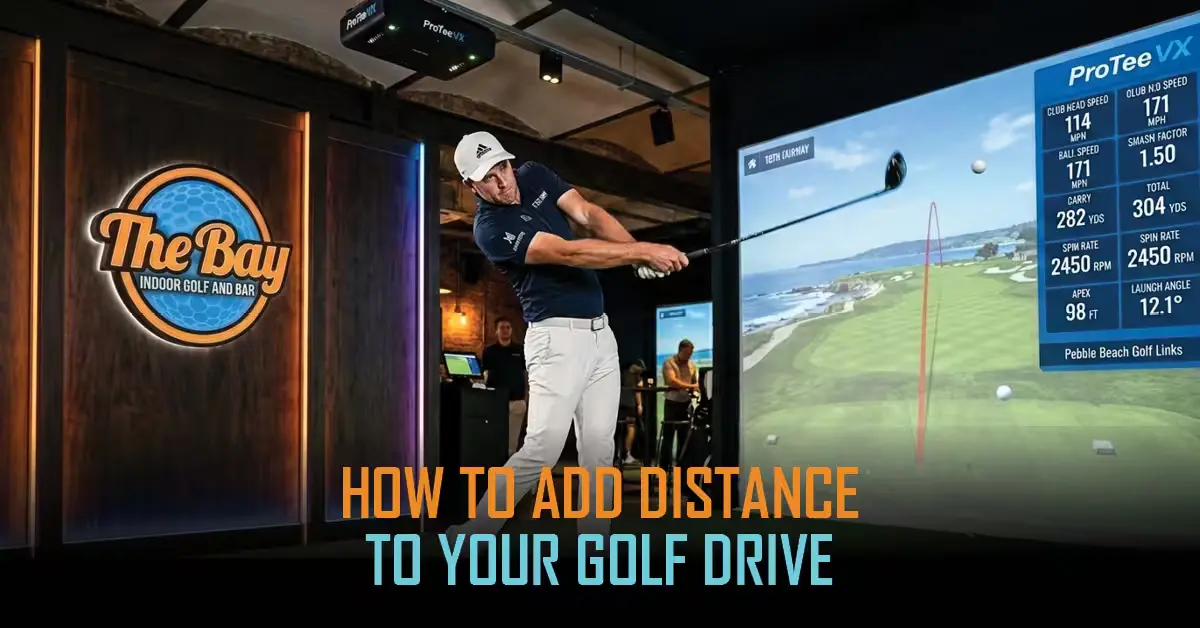
Most golfers who want more distance try to swing harder. The ProTee VX at The Bay tells a different story. From what we see on the ProTee VX, short drives usually trace back to the same three problems, and none of them are fixed by swinging harder.
The three numbers that steal distance are a Smash Factor below 1.45, a Total Spin above 3,500 RPM, and a negative Attack Angle. Fix those three numbers, and distance increases without touching swing speed. The ProTee VX shows you exactly which problem is yours after every single shot.
Why Swinging Harder Is the Wrong Fix
The instinct when you want more distance is to put more effort into the swing. In practice, swinging harder without fixing the underlying data problems usually produces a worse result, not a better one.
A harder swing with an off-centre strike produces more distance loss than a smooth swing with a centred strike. A harder swing with a downward attack angle produces more spin, which increases the ballooning trajectory that kills carry distance. A harder swing with already high spin sends the ball higher and shorter, not lower and further.
Swing speed matters, but it is the last variable to address. At The Bay, the ProTee VX approach is to fix contact quality, spin rate, and attack angle first. The power was often already there. The data shows you where it was going.
Distance Monster One: Low Smash Factor
Smash Factor is the ProTee VX’s measure of how efficiently you transfer the energy of your swing into the ball. It is calculated by dividing ball speed by club head speed. A perfect drive produces a Smash Factor of around 1.50. Anything below 1.45 means energy is being lost, and the most common cause is missing the sweet spot.
The ProTee VX shows not just the Smash Factor number but the impact location on the club face: a visual map of where the ball made contact with the face on that specific shot. A strike on the toe of the club, the outermost tip of the face, loses significant ball speed even if the swing speed was excellent. A strike near the heel, the part closest to the shaft, produces a similar loss. Think of it like hitting a cricket bat with the edge instead of the middle: the energy transfer collapses regardless of how hard the swing was.
For most recreational golfers, Smash Factor below 1.45 is a contact problem, not a speed problem. The fix is to work on centering the strike rather than increasing swing effort. Tee the ball at the right height (the equator of the ball level with the top edge of the driver), stand the right distance from the ball (arms hanging naturally, not reaching), and make a controlled swing rather than a maximum one. The ProTee VX impact location map tells you after every shot whether the strike is moving toward the centre or not.
Distance Monster Two: High Spin
Every golf ball needs some backspin to fly. The spin lifts the ball and keeps it on a stable trajectory. But there is a threshold above which spin becomes the enemy. When Total Spin goes above 3,500 RPM, the ball behaves like it is dragging a parachute.
High spin on a driver creates a steep, ballooning flight. The ball goes up quickly, reaches its peak height too early, loses forward momentum, and drops almost straight down with very little roll. You get height but not distance.
Two common causes of high driver spin are hitting down on the ball and striking the ball on the lower part of the club face. Both show up in the ProTee VX data: attack angle and impact location together tell the full picture. Fixing the attack angle, as covered in the section below, is usually the most effective way to reduce spin because it addresses the root cause of why the spin is high in the first place.
Distance Monster Three: Negative Attack Angle
Attack Angle is the direction the club head is moving at the moment it strikes the ball. A positive number means the club head is travelling upward at impact. A negative number means it is moving downward. For a driver, a negative attack angle is the most expensive data problem most golfers carry around without knowing about it.
When your attack angle reads -3 degrees or lower, your club is moving downward like an axe chopping wood as it strikes the ball. This does two damaging things simultaneously. It adds loft at impact, which increases spin, triggering the parachute effect from Distance Monster Two. And it shifts the contact point lower on the club face, reducing Smash Factor from Distance Monster One. A single swing with a negative attack angle can activate all three distance problems at once.
The fix is not to swing differently in ten different ways. It is to change one thing: the direction the club is travelling when it meets the ball.
The One Fix That Adds the Most Distance
Turn the minus sign into a plus sign. That is the fix. Moving your attack angle from negative to positive, specifically into the range of +2 to +5 degrees, triggers a combination in the ProTee VX data that adds real distance without any change to swing speed: higher launch, lower spin, better contact. Darren and Mat call it the high launch, low spin combination, and it is the most reliable distance formula in the data.
Three setup adjustments produce the change.
Move the ball forward. For a driver, the ball should sit opposite your front heel, not the middle of your stance. This single position change shifts the low point of your swing arc to before the ball, so the club is naturally travelling upward when it makes contact.
Tilt your back shoulder down. At address, drop your back shoulder slightly so you are leaning away from the target. This tilt encourages the sweeping, upward motion at impact rather than the downward chopping motion. The shoulder tilt is small, but the effect on attack angle can be significant.
Sweep, do not chop. The mental image that works for most golfers is to sweep the ball off the tee rather than hit it. Picture launching the ball over a distant wall rather than hitting it into the ground. The swing thought changes the approach angle.
Apply these three adjustments and check the ProTee VX attack angle after the next shot. For most golfers, the number shifts immediately. When the attack angle turns positive, the Smash Factor reading rises as the strike moves toward the centre, the Total Spin drops as the upward path reduces backspin, and the carry distance increases. All three distance monsters retreat at once from a single fix.
How the ProTee VX Tracks Your Distance Gains in Real Time
This is what makes working on distance at The Bay different from working on it anywhere else.
At a driving range, you watch the ball flight and estimate the distance. The feedback is slow and imprecise, and it is easy to convince yourself a change is working when the gains are small or inconsistent. At The Bay, the ProTee VX shows carry distance, ball speed, Smash Factor, Total Spin, and attack angle after every single shot. You are not estimating. You are reading exact numbers.
A golfer who arrives at The Bay with a negative attack angle and high spin can work through the setup adjustments described above and watch the data shift as they go. The ProTee VX records every one of those numbers as they change.
The data also prevents a common problem: working on the wrong fix. Many golfers who want more distance focus on swing speed drills that do nothing for their actual problem, which was a negative attack angle or a consistently off-centre strike. The ProTee VX removes the guesswork. It shows you which of the three distance monsters is taking your yards, and it confirms when the fix is working.
For golfers across Kirrawee, Caringbah, and the Sutherland Shire, this is what a session at The Bay gives you: not just more shots, but better information about your shots than you get from watching the ball fly.
The Data Does Not Lie
Swinging harder is not the answer. Smash Factor, Total Spin, and Attack Angle are the three numbers to fix first. Address those and the distance follows, without changing your swing speed, without buying new clubs, and without guessing at what is wrong.
Book a session at The Bay, hit a few drives, and look at your data. The three distance monsters will show up clearly in the numbers if they are there.
For more on improving your game, read Why Do I Slice the Golf Ball? (And How to Fix It), Do Golf Simulators Actually Improve Your Real Game?, and the Complete Guide to Indoor Golf and Golf Simulators in Sydney.
Frequently Asked Questions
How do I hit the golf ball further?
The fastest way to add distance is to fix the three data problems the ProTee VX points to in short drives: a Smash Factor below 1.45 (off-centre contact), a Total Spin above 3,500 RPM (too much backspin), and a negative Attack Angle (hitting down on the ball). The single most impactful fix is to change a negative attack angle to a positive one by moving the ball forward in your stance, tilting your back shoulder down, and sweeping rather than chopping.
How do I get more distance with my driver?
Driver distance is determined by three things working together: ball speed (a product of club head speed and contact quality), launch angle, and spin rate. A positive attack angle of +2 to +5 degrees tends to help launch and spin work together. At The Bay, the ProTee VX shows your launch angle, spin rate, and attack angle after every drive, so you can track each number as you make adjustments rather than guessing from ball flight.
How can I increase my golf swing speed?
Swing speed comes from a mix of flexibility, strength, and technique. Increasing swing speed without first fixing contact quality and attack angle will not produce distance gains, because the underlying data problems absorb the extra speed. At The Bay, the ProTee VX shows club head speed alongside Smash Factor, so you can see whether extra speed is translating to ball speed or being lost to poor contact.
What data does a launch monitor give you?
A launch monitor measures the key parameters of your swing and the resulting ball flight at the moment of impact. The ProTee VX at The Bay captures ball speed, club head speed, Smash Factor, launch angle, total spin, backspin, side spin, spin axis, attack angle, club face angle, club path, and impact location on the face, among others. Together these give you a picture of every shot you hit, which makes identifying and fixing distance problems faster than working from feel and ball flight observation alone.