
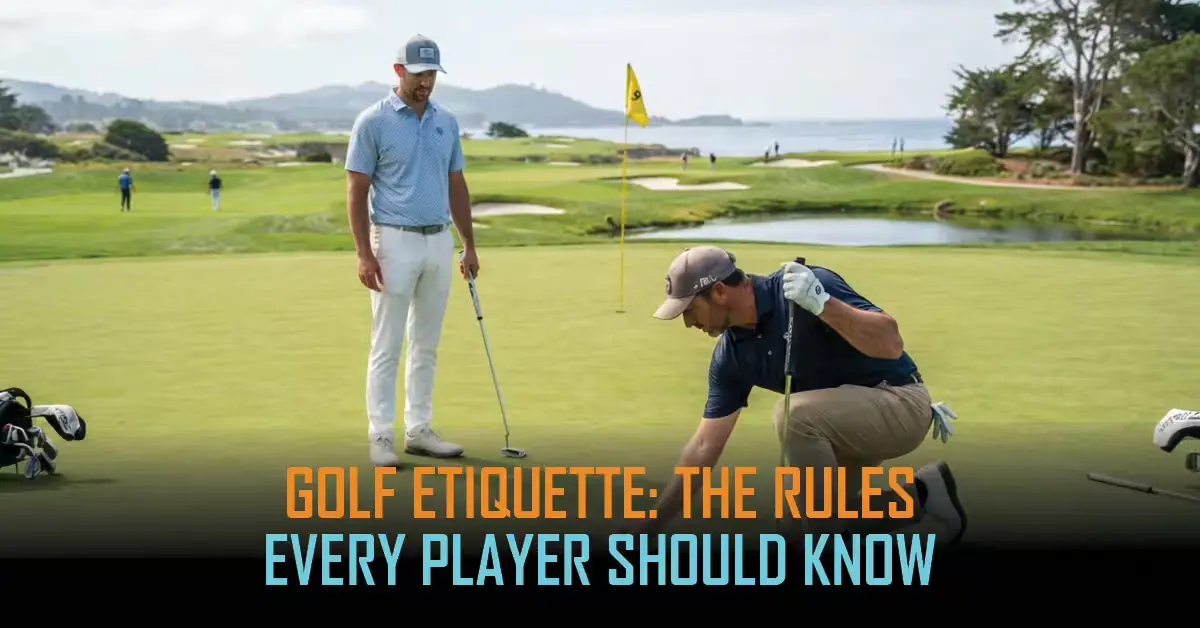
Golf etiquette is the code of conduct that governs how players behave on the course. It is not the Rules of Golf, which cover what is and is not permitted during play. Etiquette covers how you conduct yourself: toward other players, toward the course, and toward the pace of the game.
Most etiquette rules exist for two reasons: to protect the playing surface and to protect the experience of other golfers. Know them before you play. The game is harder to enjoy when you do not.
On the Tee Box
The tee box is where each hole begins. The player with the lowest score on the previous hole tees off first. This is called having the honour. On the first tee, honours are determined by agreement or a coin toss.
Stand behind and to the side of the player hitting. Do not stand in their eyeline or in the line of their swing. Do not talk, move, or make noise during another player’s swing. Wait until they have completed their shot before moving.
Tee the ball between the markers and up to two club-lengths behind them. That is the teeing area. Playing your tee shot from outside it is a two-stroke penalty in stroke play, and you then play again from inside the teeing area.
On the Fairway
Stand where you are not in the sightline or peripheral vision of the player hitting. If you are walking with a group, stop when someone is about to play.
Do not walk ahead of the player when they are preparing to swing. On a buggy, park to the side and behind the ball, not in front of it.
Replace divots. When your iron cuts into the turf, replace the divot and press it down. Use the sand-and-seed mix if provided. Divots left on the fairway damage the course for every golfer who follows.
If your ball may be lost or out of bounds, play a provisional ball before searching. This keeps the group behind you moving.
On the Green
Mark your ball when it reaches the green. Place a marker directly behind the ball before picking it up. This lets other players putt without obstruction.
Repair pitch marks. When a ball lands from height, it leaves an indentation in the surface. Use a divot tool to push the edges inward and level the surface.
Do not walk on another player’s putting line. The putting line is the path between their ball and the hole. Footprints affect the roll. Walk around it.
Tend the flag when asked. Hold the flagstick while a player putts, then remove it as the ball approaches the hole. Under the current Rules of Golf (R&A 2019 update), the flag may stay in the hole during putting at the player’s discretion.
Leave the green promptly. Record your scorecard at the next tee, not on the green. Every group behind you is waiting.
Pace of Play
Slow play is the most common source of conflict on a golf course. It is also the most preventable.
Ready golf is the accepted standard in recreational play. Play when you are ready, not in strict order of who is furthest from the hole. In stroke play, the Rules of Golf allow and encourage playing out of turn in a safe and responsible way.
Be ready when it is your turn. Club selection and reading your lie should happen while others are playing. A player who only begins thinking when it is their turn consistently delays the group.
Keep up with the group in front. The reference point for pace is not the group behind you. It is the gap to the group ahead. If that gap is opening, pick up the pace.
Clubs set their own pace-of-play policies, so ask at the pro shop what applies at your course.
Scoring and Honesty
Golf is self-refereed. Players call penalties on themselves when they breach the rules, even when no one else saw it. This is the foundation of the game’s integrity.
Count every stroke. A stroke is any forward attempt to hit the ball, including air shots. If the club moves forward with intent to hit and misses, it counts. It does not count if you stop the downswing before reaching the ball.
A lost ball incurs a one-stroke penalty plus distance. Return to where you played the last shot and play again. An out-of-bounds ball carries the same penalty: stroke and distance.
A red-staked penalty area allows a drop within two club-lengths of where the ball crossed the edge. No nearer the hole. One-stroke penalty.
Scoring terms: eagle is two under par, birdie is one under, par is on par, bogey is one over, double bogey is two over. In Stableford format you earn two points for par, three for birdie, one for bogey, and zero for double bogey or worse.
Mobile Phones and Distractions
Switch your phone to silent before you play. A ringing phone during another player’s swing is a serious breach of etiquette. Manage calls and notifications between holes.
Do not check yardage apps while another player is mid-routine. Confirm your numbers before it is your turn.
What The Bay Teaches You
At The Bay, the ProTee VX handles the data. Attack angle, spin rate, carry distance, face angle: every variable is recorded and displayed after every swing. You do not guess what went wrong. The system tells you.
That same principle applies to etiquette on a real course. Some beginners feel anxious about playing outdoors, and part of that is not knowing the code. Learn it here first. At The Bay, you build the swing, understand the data, and leave knowing how to behave on a real course.
Darren and Mat are happy to walk through course etiquette during any session. Neither of them holds a coaching qualification, so it is a chat between golfers, not a lesson. Ask the question. The data improves your game. Knowing the code makes the game worth having.
For more on taking your game further, read How to Get a Golf Handicap in Australia, Golf Scoring Explained, and The Complete Guide to Indoor Golf and Golf Simulators in Sydney.
Frequently Asked Questions
What is golf etiquette?
Golf etiquette is the code of conduct governing player behaviour on a golf course. It covers pace of play (keep up with the group in front, play ready golf in casual rounds), care for the course (replace divots, repair pitch marks, rake bunkers), behaviour around other players (stand still and silent during swings, do not walk on putting lines), and honesty in scoring (self-refereeing is the foundation of the game). Etiquette is distinct from the Rules of Golf, which govern what is and is not permitted during play. Most clubs expect players to know both before taking the course.
What is the most important rule in golf?
One of the most basic rules in golf is play the ball as it lies. Rule 9.1 of the Rules of Golf requires you to play the ball from where it comes to rest, except when the Rules require or allow you to play from another place or to lift and replace it. It is the foundation of the game’s integrity, alongside the self-refereeing standard. From an etiquette standpoint, the equivalent principle is pace of play. Every player on a course is responsible for keeping up with the group in front. Consistent slow play is the most common damage to other golfers’ experience.
What is slow play in golf?
Slow play is when a group falls behind the group ahead, creating a backlog across the course. Common causes include insufficient preparation before shots, long ball searches, slow movement between shots, and excessive practice swings. Ready golf helps in casual rounds, and clubs set their own pace-of-play policies.
What is a gimme in golf?
A gimme is an informal concession in match play where one player concedes a short putt to their opponent. The opponent adds one stroke to their score without holing the putt. Under the Rules of Golf, gimmes are only valid in match play. In stroke play, every stroke must be holed out.