
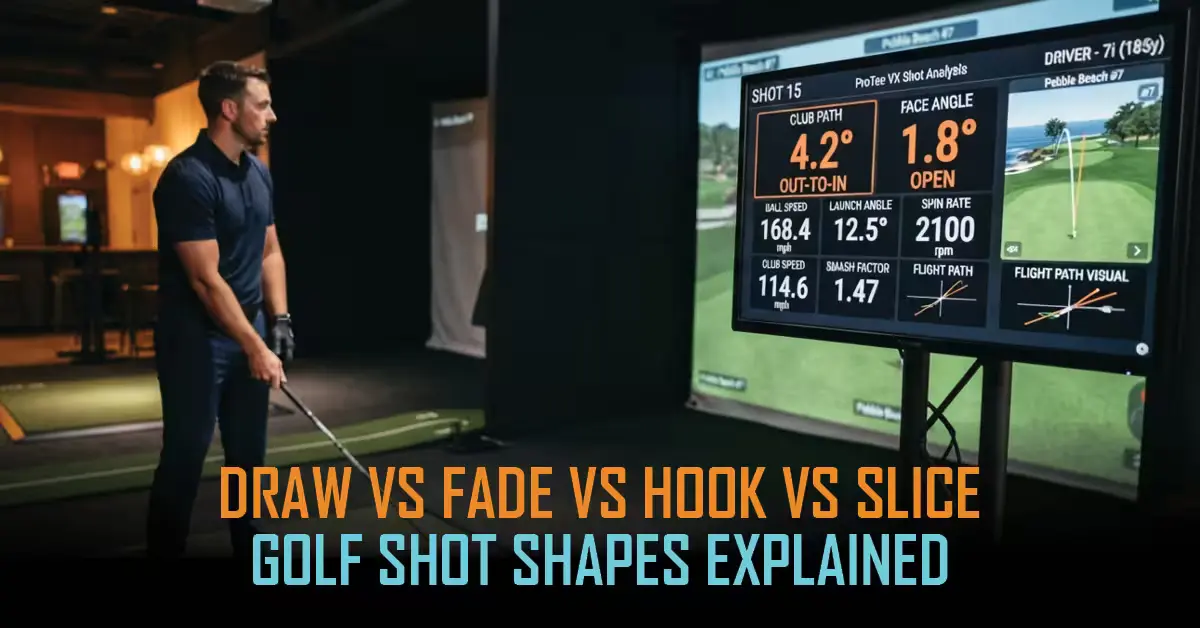
There are four ball-flight curves in golf. Two are intentional. Two are accidents. Most recreational golfers cannot tell which they are hitting.
A draw and a fade are controlled shot shapes. They are planned before the swing and executed with a specific club path and face angle. A hook and a slice are the same curves, but uncontrolled and significantly larger. At The Bay, the ProTee VX shows the data that separates them after every shot.
The Two Good Curves: Draw and Fade
The draw curves gently from right to left for a right-handed golfer. The ball starts slightly right of the target and moves back toward it. A controlled draw produces lower spin and a more penetrating ball flight. That means more distance and more roll after landing.
The draw requires an in-to-out club path at impact. The face must be closed relative to the path but open relative to the target line.
The fade curves gently from left to right for a right-handed golfer. The ball starts left of the target and curves back. A fade produces higher spin and a softer landing than a draw. That makes it easier to stop the ball on the green.
The fade requires an out-to-in club path with a face open relative to the path.
Both shapes are intentional. The golfer chose them, set up for them, and executed the required combination. The curve is small, predictable, and finishes near the target.
The Two Bad Curves: Hook and Slice
The hook is a draw that lost control. It curves hard right to left. It starts right of the target and keeps going left, well past it. The cause is the same as a draw: an in-to-out path with a closed face. The difference is the face is much more closed relative to the path. More sidespin, a sharper curve, a ball that finishes well left of the target.
The slice is a fade that lost control. It curves hard left to right, often dramatically, and almost always finishes well right of the target.
Think of it like this: making a ball curve gently around a defender is a draw. Kicking your shoe off sideways into someone’s garden is a slice. Both involve a curve. Only one was on purpose.
The cause of a slice is an out-to-in path with a face significantly open relative to that path. The large gap generates high sidespin that overwhelms the ball’s forward flight.
The hook and slice are not different shots from the draw and fade. They are the same mechanics with a larger gap.
Why Most Golfers Cannot Tell the Difference
It is one of the most common patterns in recreational golf. A player hits a ball that curves sharply right, 30 metres offline. They watch it go and say: good fade. They know the vocabulary. They do not know which shot they actually hit.
When you play outdoors, you see the outcome and guess the cause. The ball went right. You assume the face was open. You might be correct. You might have had an out-to-in path with a square face. Or a square path with an open face. Without data, all you have is the result and a theory.
At The Bay, the ProTee VX removes the theory. It shows the club path, the face angle at impact, and the gap between them. That gap determines the shot shape. A player who calls it a fade can see immediately whether the path was genuinely out-to-in or whether the face was simply open at impact. Those produce similar-looking ball flights. The data tells you which one it was.
What the ProTee VX Shows You
Two numbers determine shot shape: club path and face angle.
Club path is the direction the club head is travelling at impact. It is measured in degrees relative to the target line. A positive number means in-to-out, which produces draw or hook mechanics. A negative number means out-to-in, which produces fade or slice mechanics.
Face angle is where the club face is pointing at impact, also in degrees relative to the target line. A positive number means the face is open (right of target for a right-hander). A negative number means it is closed.
When the face is closed relative to the path, the ball curves right to left. When the face is open relative to the path, the ball curves left to right. The size of the gap determines how much curve.
A draw typically shows a path of +4 degrees and a face of +1 degree. The face is 3 degrees closed relative to the path. Gentle right-to-left curve. A slice typically shows a path of -6 degrees and a face of +3 degrees. The face is 9 degrees open relative to the path. Large left-to-right curve.
These numbers appear on the ProTee VX output after every shot at The Bay. A player can see immediately whether their path is out-to-in or their face is simply open. The data does not guess. It shows what happened at the exact moment of impact.
Darren and Mat use these two numbers when they help players with their swing. The player hits. The data appears. There is no room to misread it. Neither of them holds a coaching qualification.
How to Start Shaping Shots Intentionally
To hit a draw, start with an in-to-out club path. Set up with feet, hips, and shoulders aligned right of the target. Close the face slightly so it points at the target while the path moves right. The ball should start right and curve back.
To hit a fade, start with an out-to-in club path. Set up aimed left of the target. Open the face slightly so it points at the target while the path moves left. The ball should start left and curve back.
The ProTee VX shows whether the adjustment worked. The path number shows whether it changed. The face angle shows whether the face moved as intended. The ball flight on the GSpro course shows the result. Every cause-and-effect chain is visible on every shot.
For more on improving your ball flight, read Why Do I Slice the Golf Ball? (And How to Fix It), How to Add Distance to Your Golf Drive, and The Complete Guide to Indoor Golf and Golf Simulators in Sydney.
Frequently Asked Questions
What is a draw in golf?
A draw is a controlled ball flight curving gently from right to left for a right-handed golfer. The ball starts slightly right of the target and moves back toward it. It is produced by an in-to-out club path with a face closed relative to the path. A draw produces lower spin and a more penetrating flight than a fade. It generates more distance and roll after landing. On the ProTee VX at The Bay, a draw shows as a positive club path number with a face angle lower than the path number.
What is a fade in golf?
A fade is a controlled ball flight curving gently from left to right for a right-handed golfer. The ball starts slightly left of the target and curves back. It is produced by an out-to-in club path with a face open relative to the path. A fade produces higher spin and a softer landing than a draw, making it easier to stop the ball on the green. On the ProTee VX, a fade shows as a negative club path number with a face angle higher than the path number.
What is the difference between a draw and a hook?
Both curve right to left for a right-handed golfer. Both are produced by an in-to-out club path with a face closed relative to the path. The difference is the size of the gap. A draw has a small gap, producing a gentle, controlled curve. A hook has a large gap, producing a sharp, uncontrolled curve that finishes well left of the target. On the ProTee VX, you can see the exact degree difference between path and face angle on every shot. That number separates a useful draw from a damaging hook.
What causes a hook in golf?
A hook is caused by an in-to-out club path with a face significantly closed relative to that path at impact. The large gap generates high sidespin in a right-to-left direction. At The Bay, the ProTee VX shows the club path and face angle numbers that confirm the cause. A hook and a bad draw look similar to the eye. The data shows which problem you are fixing.