
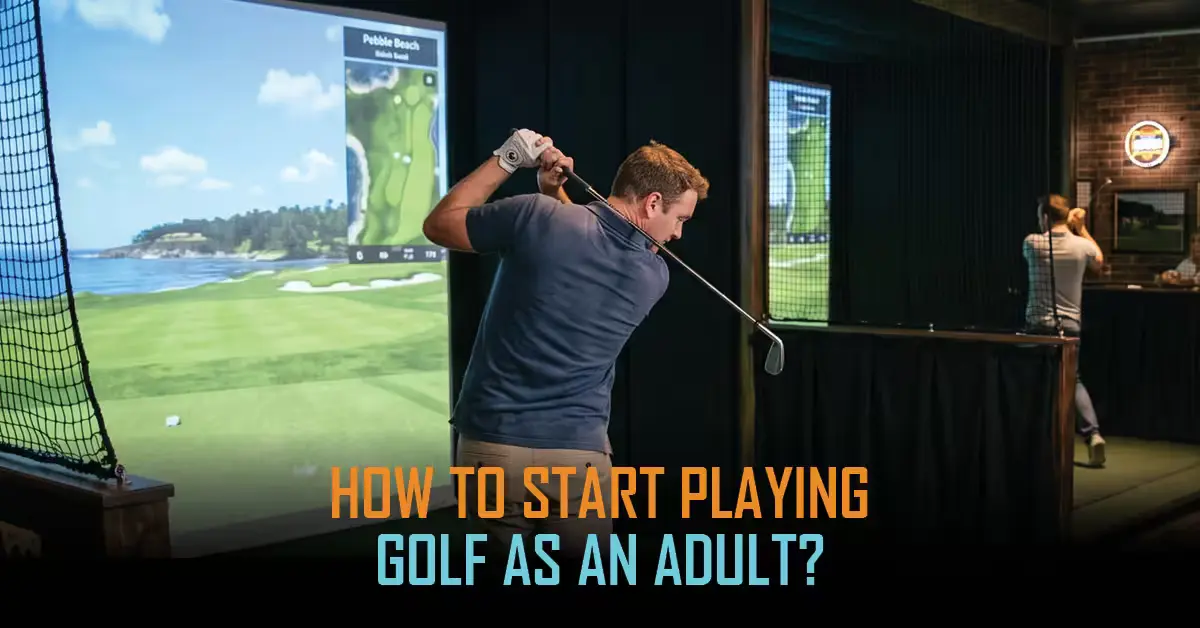
The most common thing adult beginners say after a first simulator session is some version of the same sentence: I should have started years ago.
The second most common thing they say is: when can I book again?
The idea that there is a right age to start golf is one of the game’s most persistent and most damaging myths. Golf does not have a window. You can start at 30, at 40, at 50, and build a game that gives you decades of enjoyment. What you need is the right environment to start in. That environment matters more than the age you begin.
The Idea That It Is Too Late
Most adults who have not played golf carry a version of the same belief.
Everyone who plays started as a kid. The game has a language, a culture, and a set of unwritten rules that everyone else already knows. Turning up as a beginner at 38 means exposing your ignorance in public, on a course full of people who have been doing this since they were ten.
None of that is accurate. The game is more accessible than it has ever been. And the environment in which you start makes almost all the difference. A crowded driving range where strangers watch your swing is one environment. A private bay where the only people who can see you are the ones you brought is another.
The Bay was built for the second kind of start.
What Starting Golf as an Adult Actually Looks Like
An adult beginner at The Bay does not walk into a lesson.
They walk into a bay. Their Hosts set up the simulator, explain the ProTee VX, and let the group choose a course or a practice format. Then they start hitting. The first few shots are usually a mix of good contact and bad contact, and the ProTee VX tells you exactly which is which. Ball speed. Club path. Launch angle. The data removes the guesswork and replaces it with information.
That information is what makes the adult learner different from the ten-year-old at junior golf. Adults learn faster when they understand the why behind each result. They do not just want to be told to keep their head down. They want to know what their swing data shows, what the pattern is, and what one adjustment would produce a better result. The ProTee VX gives them that. And it gives it to them on every single shot.
Why Indoor Golf Accelerates the Learning Curve
Starting on an outdoor course is the hardest possible way to learn golf.
You are managing a long walk, variable terrain, weather, other golfers, and course etiquette while trying to learn a genuinely complex motor skill. The feedback on each shot is minimal: you see the ball land, but you do not know why it went there. The repetitions are slow and the lessons are expensive per swing.
Indoor golf inverts all of that. At The Bay, you stand on a level mat in a climate-controlled bay and hit shot after shot. The ProTee VX reads every swing and shows you the data. You are not guessing at what went wrong. You are reading it. Club face angle was open. Attack angle was too steep. Launch direction was two degrees left. Those are fixable things, and knowing them makes them fixable faster.
The adult who does ten sessions at The Bay before they step onto a real course arrives at that course as a golfer. They understand the shape of their swing, the distances their clubs carry, and what a solid strike feels like.
The Things That Hold Adults Back
There are four beliefs that stop adults from starting golf. All four are wrong.
The first is that you need your own clubs. You do not. Speak to your Hosts on arrival. For a first visit, understanding the swing and reading the data matters more than having fitted equipment. When you are ready to invest in clubs, read The Beginner’s Guide to Golf Clubs: What You Need and What You Don’t.
The second is that you need to be fit or athletic. Golf is a technical sport, not a physical one. Adults of every fitness level find their way into a workable swing. The ProTee VX measures what your body does and tells you what to adjust. That is a process, not a test.
The third is that you need to book lessons first. You do not. Get a feel for the swing and the data first, and lessons become far more useful. Darren and Mat both run lessons. Neither holds a coaching qualification, so they help with your swing and nothing more formal. Contact either of them directly when you are ready.
The fourth is that you will embarrass yourself. In a private bay, the only people watching you are the ones you came with.
What to Expect in Your First Three Sessions
A rough picture of how most adult beginners progress at The Bay.
Session one: The focus is contact. Getting the club to meet the ball consistently is the first milestone. The ProTee VX data shows where the face is at impact. Most beginners leave session one having hit at least a handful of clean shots, which is enough to feel the game.
Session two: The data starts to mean something. You have a baseline from session one. You can see whether your ball speed has improved, whether your club path is more consistent, whether your dispersion is tightening. Patterns become visible. One or two things to work on become clear.
Session three: You start making decisions. Club selection. Course management. The difference between a punch shot and a full swing. The game starts to reveal itself as a game rather than just a skill to acquire.
The Best Time to Start Was Yesterday
The Bay is in Kirrawee, serving Kirrawee, Caringbah, and the Sutherland Shire.
Book a bay, bring a mate, and start. You do not need equipment, experience, or a plan. You can book one, two or three hours, and all you need is an openness to enjoying yourself. For more on what a first visit looks like, read Is Indoor Golf Good for Beginners? What to Expect on Your First Visit. For the complete guide to indoor golf in Sydney, read The Complete Guide to Indoor Golf and Golf Simulators in Sydney.
Frequently Asked Questions
How do I start playing golf?
The easiest way to start is to book a bay at an indoor golf venue and hit balls. At The Bay, the ProTee VX gives you immediate data on every shot: what your club did, where the ball launched, how far it carried. You do not need lessons before your first visit and you do not need your own clubs. Start, read the data, and repeat. Once you have a feel for the game, Darren and Mat both run lessons. Neither holds a coaching qualification, so they help with your swing and nothing more formal.
Is it too late to learn golf?
No. Adults start golf at every age. The idea that golf requires a childhood start is a myth. What it requires is the right environment and useful feedback. At The Bay, the ProTee VX provides immediate, specific data on every shot you hit. The game does not close at a certain age. It just takes the right first step.
Can I start playing golf at 30, 40, or 50?
Yes, at any of those ages. The Bay is built for adult beginners across all age groups. Golf is a technical sport, not a physical one. A consistent swing, an understanding of your data, and regular repetition are what improve your game. None of those require youth. What they require is the right setup. A private bay with immediate shot feedback is a better learning environment at 45 than a crowded driving range at 15.
Is golf hard to learn?
Golf has a reputation for being hard to learn because most people start in poor learning environments. On a real course, feedback is slow, distractions are constant, and the cost per shot is high. At The Bay, those barriers disappear. You hit a ball, the ProTee VX tells you what your swing did, and you hit another. That feedback loop makes the game easier to learn. The game itself is genuinely challenging, and that challenge is part of what makes it interesting over a lifetime. But starting it does not need to be hard.