
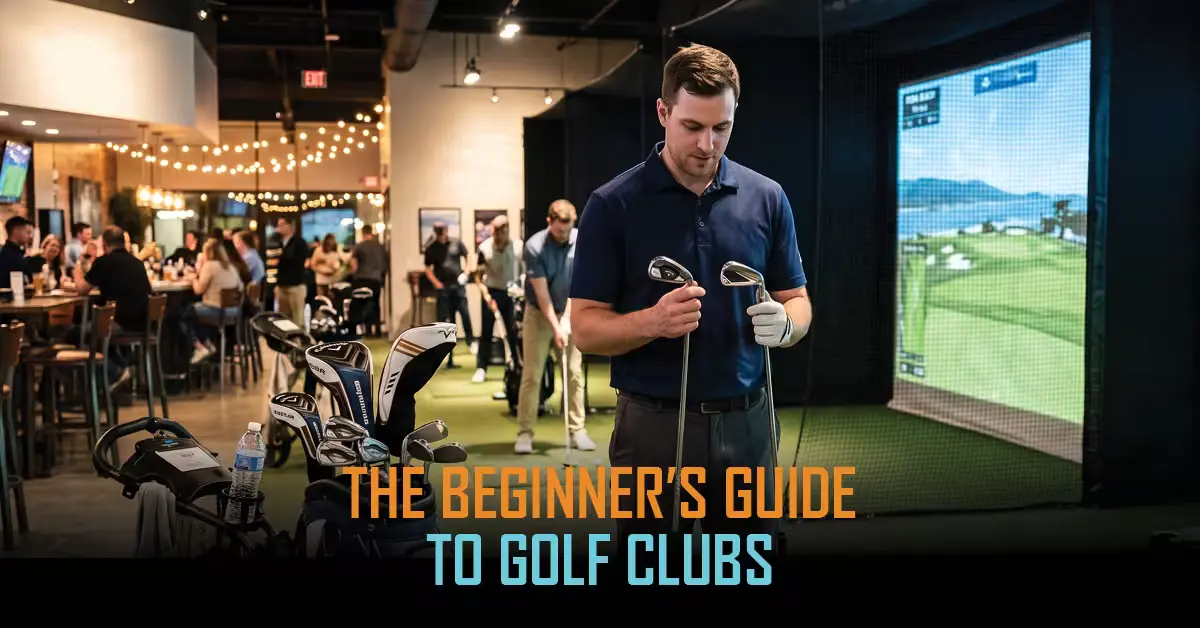
A beginner needs 7 clubs, not 14. A driver, a hybrid, three irons, a pitching wedge, and a putter will cover every situation you will face in your first year of golf. Before you buy a single club, come into The Bay in Kirrawee, hire a set, and hit your first real shots on the ProTee VX simulator.
Most beginners get this backwards. They buy a full bag before they know how they swing, and they usually buy the lowest-priced set on the shelf. The result is a set of clubs that fights them on every shot, slows down the learning curve, and ends up replaced six months later anyway.
Hire first. Learn your swing. Buy the right clubs once you know what right looks like for you.
The 7 Clubs a Beginner Actually Needs
Golf allows 14 clubs in a bag. A beginner does not need 14. You need 7 clubs that cover the range of distances you will face, with enough forgiveness on each one that a mishit does not punish you off the course.
Here is the set that works for almost every adult beginner.
Driver: for tee shots on par 4s and par 5s. Choose a large head with a regular or senior shaft flex, depending on your swing speed. The large head creates a wider sweet spot. Forgiveness matters far more than distance when you are starting out.
5-hybrid or 7-wood: this replaces the long irons that most beginners cannot hit. A 3-iron or 4-iron requires a very precise strike to get the ball airborne, and that precision takes years to develop. A hybrid covers the same distance with a much larger, more forgiving head. If there is one equipment decision that makes an immediate difference to a beginner’s round, this is it.
7-iron: the workhorse of any beginner’s bag, and the club to learn first. It sits in the middle of the set, has enough loft to get the ball up easily, and produces a flight that shows you exactly what your swing is doing. At The Bay, the ProTee VX data on your 7-iron swing tells you more about your game than almost any other club.
8-iron and 9-iron: your scoring irons for approaches inside 150 metres. These are consistent, forgiving, and the clubs you will use most often on any course.
Pitching wedge: essential from the start. Inside 100 metres, this is your go-to club. Most beginner sets include one automatically.
Putter: the most important club in the bag. Spend more on your putter than on any other individual club, and take the time to find one that feels right in your hands.
That is your seven. Everything else, the low irons, the extra wedges, the fairway woods, can wait until you have played enough to know what you actually need.
What the Numbers on Your Clubs Actually Mean
The number on an iron tells you the loft angle of the face. Lower number means lower loft, longer distance, and a harder shot to execute. A 3-iron has a nearly flat face and requires a precise, sweeping strike. A 9-iron has a steep face that gets the ball airborne almost automatically.
This is why beginners struggle with low-numbered irons. A 3-iron or 4-iron punishes the slightest mistake with a thin, low shot that goes nowhere. The same mistake with a 7-iron produces a perfectly acceptable result.
The practical rule for beginners is simple: start from the middle of the bag and work outward. The 7-iron is your foundation. Master the strike first, build consistency over several sessions, and only then start to add clubs at either end of the set. There is no value in carrying a 3-iron you cannot hit. A hybrid covers the same distance and gives you a result you can actually use.
Understanding loft also helps you understand why the driver is counterintuitive. It has far less loft than the irons, which means a slightly off-centre strike produces a wild result. It is not the first club you should spend your session time on, even though it is the most exciting one to hit.
The Budget Club Trap (And Why It Costs You More)
The most common mistake beginners make is buying the lowest-priced set available. The logic seems sound: I do not know if I am going to stick with this, so I do not want to spend much. In practice, budget clubs work against you at every stage of learning.
Low-quality shafts produce inconsistent flex on every swing. The shaft is not behaving the same way twice, which means the ball is not going the same place twice, and the data you are trying to learn from is not telling you anything consistent. You cannot diagnose a swing that is fighting inconsistent equipment.
Poorly cast club heads reduce forgiveness on off-centre hits. When you are learning, most of your hits are off-centre. A well-designed club head with a proper perimeter weighting still produces a reasonable result when you miss the sweet spot. A poorly made head punishes you with a shot that barely moves, or veers sideways.
A mid-range set from a reputable brand costs more upfront. But it gives you clubs that respond predictably to your swing, which means the learning curve is shorter, the frustration is lower, and you are not buying a replacement set after six months when the budget ones fail to improve with you.
The correct framing is not what the clubs cost today. It is what the cost per round becomes over time. The more you play, the cheaper your clubs become per session. Spend a bit more once and let the game repay it.
Try Before You Buy at The Bay
At The Bay, we hire clubs. You walk in, tell your Hosts what you need, and they set you up for your session. No purchase required, and no prior experience necessary.
That first session on the ProTee VX tells you more about what clubs suit your swing than any online guide can. The system measures ball speed, launch angle, spin rate, club path, and a range of other data points on every single shot. After an hour, you know your average carry distance with the 7-iron. You know your swing speed with the driver. You know whether your tendency is to hit left or right, and by how much.
That data is the foundation for buying well. When you walk into a golf retailer knowing your swing speed, you can ask for the right shaft flex immediately. When you know your current 7-iron distance, you know what gap you need to fill with a hybrid. You are buying with real numbers in your hands, not a guess based on what the salesperson suggests.
For golfers across Kirrawee, Caringbah, and the Sutherland Shire, hiring a set at The Bay before buying your own is the single most useful first step. You leave the session better informed about your swing than most golfers are after a year of playing on a real course.
When You Are Ready to Buy, Here Is What to Look For
Once you have a few sessions behind you and a clearer picture of your swing, here is how to spend wisely.
Choose cavity-back irons, not blade irons. A cavity-back iron has a hollowed section across the back of the head that distributes the weight around the perimeter. This gives you a larger effective sweet spot and produces a more forgiving result on off-centre hits. A blade iron concentrates all the weight behind a small sweet spot. Tour players use blades because they can control the face with exceptional precision. Beginners cannot, and should not try. Every beginner iron set should be cavity-back. This is not a preference; it is the correct choice for the stage of the game you are at.
Match shaft flex to your swing speed. A stiff shaft requires a fast swing to flex and load correctly. A slow swing with a stiff shaft produces low, weak shots that lose distance and accuracy. Most beginners and moderate-pace swingers need a regular or senior flex shaft. Your ProTee VX data from sessions at The Bay gives you your actual swing speed, so you can ask for the right flex with confidence instead of guessing.
Test the clubs before you buy them. Go to a retailer that has a launch monitor or a hitting bay, and hit 10 shots with the clubs you are considering. Look at the carry distance, the dispersion, and how consistent the results are. Never buy a full bag online without hitting them first. A set that looks good in a review but does not suit your swing speed or your strike tendencies is money spent in the wrong direction.
Buy a set that gives you room to grow. The best beginner sets are designed so that the forgiveness is built into the head shape, not the shaft or the lie angle. As your swing improves, a good set of cavity-back irons will still serve you at a much better level of play than it served you on day one. You are not buying clubs for today. You are buying clubs for the next two to three years of your game.
The Right Clubs Make the Right Start
Every golfer who has been playing for a few years knows someone who bought the wrong clubs too early, got frustrated, and almost gave up. The equipment was fighting them as much as the swing was. It is one of the most avoidable obstacles in the game.
Book a session at The Bay, hire a set, and let the ProTee VX show you what your swing actually does. When you know the numbers, buying the right clubs becomes a straightforward decision instead of a guess. Come back a few times, build some consistency, and then invest in a mid-range set that will grow with your game.
Book a Bay at thebaygolf.com.au/book.
For more on getting started, read Is Indoor Golf Good for Beginners? What to Expect on Your First Visit and How to Start Playing Golf as an Adult (It’s Not Too Late). For the complete guide, read The Complete Guide to Indoor Golf and Golf Simulators in Sydney.
Frequently Asked Questions
What golf clubs does a beginner need?
A beginner needs 7 clubs: a driver, a 5-hybrid or 7-wood, a 7-iron, an 8-iron, a 9-iron, a pitching wedge, and a putter. A full 14-club set is unnecessary until your swing is consistent enough to benefit from the additional options. Start with 7, learn each club across a handful of sessions at The Bay, and add clubs as your distances and shot shapes become predictable.
What is the difference between a driver and an iron?
A driver has less loft and a larger head than any iron. It is designed to launch the ball as far as possible off a tee on long holes. Irons have progressively higher loft across the set, shorter shafts, and are used for approach shots from the fairway and rough. The higher the iron number, the higher the loft and the easier the ball is to get airborne. Most beginners find mid-irons (7, 8, 9) much easier to hit consistently than either the driver or the low-numbered irons.
What is a hybrid golf club?
A hybrid combines the long shaft and sweeping swing of a fairway wood with the compact head profile of an iron. It was designed specifically to replace the long irons (3, 4, 5) that most recreational golfers, and almost all beginners, struggle to hit consistently. The wider sole and lower centre of gravity make it far easier to get the ball airborne from any lie, with more forgiveness on off-centre contact than a comparable iron. Every beginner bag should include at least one hybrid.
How do I know which club to use?
Choose based on the distance to your target and the lie of the ball. Driver for tee shots on long holes, irons for fairway and rough approach shots, pitching wedge inside 100 metres, putter on the green. The specific club selection within those categories depends on your carry distances, which become reliable data after several sessions at The Bay. The ProTee VX records your carry distance with every club after every shot, so within a few visits you have a real number for each club rather than an estimate.