
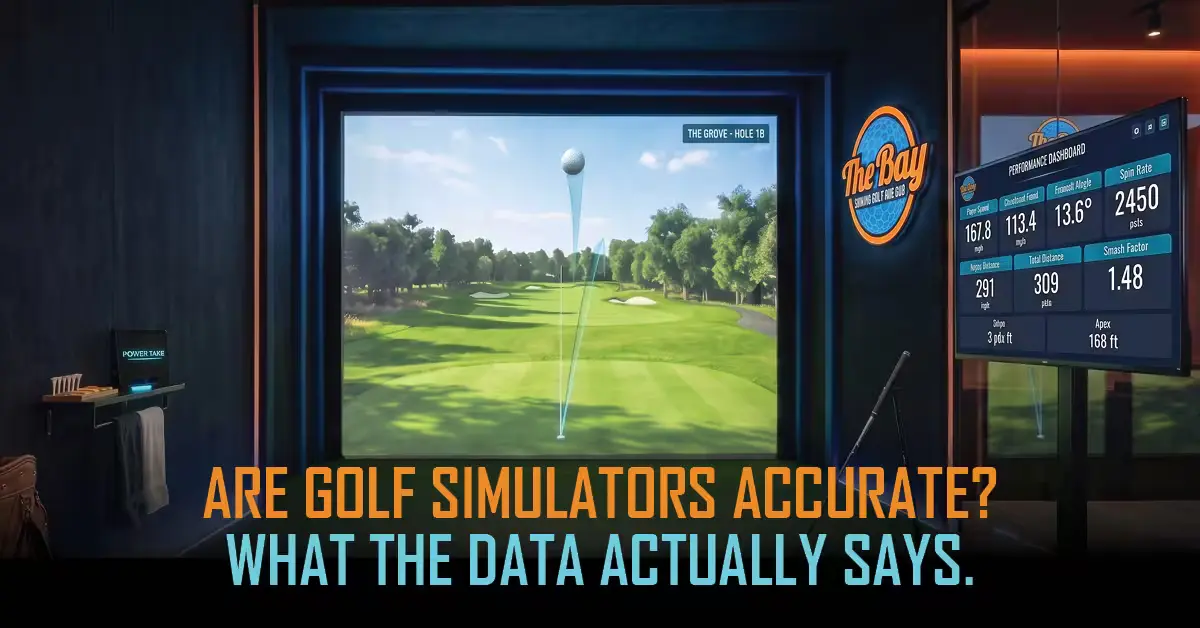
Modern golf simulators are highly accurate. They achieve this by measuring the physical data of your shot at the moment of impact, using that data to calculate the ball flight you would get outdoors, rather than guessing from video tracking.
At The Bay in Kirrawee, co-founder Darren Chapman describes it directly: “Players hit real golf balls, with real clubs, into a real impact screen.”
The ProTee VX launch monitor then does the measuring: capturing your ball speed, launch angle, spin axis, and clubhead path at impact, with results displayed live via ProTee Labs on the bay side display. You are not playing against a simulation of golf. You are playing with your actual shot data, in real time.
Here is exactly what that accuracy looks like, and why it matters for your game.
What “Accurate” Actually Means in Golf Simulator Terms
When people ask whether a golf simulator is accurate, they are usually asking: will the ball go where it looks like it goes on the screen?
The answer is yes, but it is worth understanding how. A simulator does not track the ball after it leaves the mat. It reads the launch conditions at the moment of impact: ball speed, launch angle, spin rate, and clubhead path.
Those four measurements determine ball flight. The simulation then calculates where that ball would travel on an outdoor course.
How Golf Simulators Measure Your Shots
At The Bay, you hit a real golf ball with your own clubs into a full-sized impact screen. This matters for accuracy: the shot is physically genuine before any measurement takes place. The ProTee VX camera-based launch monitor uses two swing cameras mounted on the ceiling and captures your shot data at the exact moment of impact.
Those readings feed into ProTee Labs, which displays your live data on the bay side display: ball speed, launch angle, spin axis, clubhead speed, and your clubhead path through the strike zone. You see the numbers within seconds of hitting the shot.
The GSpro simulation software then takes those measured launch conditions and renders the ball flight on the main projector screen: the course you see, the distance you hit, the fade or draw you produce. What you see on the main screen is what your shot would do outdoors.
Ball Speed and Clubhead Speed: What the Numbers Mean
What is ball speed in golf?
Ball speed is the velocity of the golf ball immediately after impact with the clubface, measured in kilometres per hour or miles per hour. It is the single most important driver of distance: higher ball speed means more distance, all else being equal. ProTee Labs displays your ball speed on the bay side display after every shot.
What is clubhead speed in golf?
Clubhead speed is the velocity of the clubhead at the moment it strikes the ball, measured in kilometres per hour or miles per hour. The relationship between clubhead speed and ball speed is called the smash factor: a higher smash factor means more of your clubhead energy is transferring into the ball. At The Bay, ProTee Labs shows your clubhead speed alongside your ball speed so you can see exactly how efficiently you are making contact.
Together, these two data points tell you more about your swing in a single bay session than most golfers learn across an entire season outdoors.
How Accurate Is a Golf Simulator Compared to Real Golf?
Ball speed: Velocity of the ball at impact, measured in km/h or mph. The primary predictor of carry distance.
Launch angle: Angle of ball departure from the clubface, measured in degrees. Determines trajectory and total distance.
Spin axis: Tilt of the spin axis left or right, measured in degrees. Determines whether you hit a fade, draw, slice, or hook.
Clubhead speed: Speed of the club at impact, measured in km/h or mph. Drives your potential ball speed and distance ceiling.
Carry distance: Calculated from all of the above measurements. What you would get on an outdoor course.
The main variables outdoors are wind, ground conditions, and altitude: things no simulator can replicate, nor should they try. What the simulator does replicate is the flight of the ball from club to landing, which is the part of golf that reflects your technique.
For technique work, practice, and improvement, the simulator data is directly applicable to your outdoor game.
Why Accuracy Matters for Improvement
The reason accuracy matters is not just for entertainment. It is because inaccurate data leads to inaccurate practice.
If a simulator told you your drive went 250m when it would actually go 180m outdoors, you would build a false picture of your game. Accurate data, your real launch angle, your real spin axis, your real ball speed, gives you something genuine to work with.
At The Bay, the ProTee Labs data your group sees on the bay side display is your actual numbers, and those numbers drive your ball flight on well-known courses. The courses run under altered names, such as Georgia Golf Club for the Augusta National layout.
If you want to understand whether simulators improve your real game or compare indoor golf against the driving range for practice purposes, those articles go deeper into what the data does for your handicap.
For a full breakdown of how GSpro and ProTee Labs measure every shot, including what each data point means and how to use it, see our technology explainer.
What Affects Simulator Accuracy: The Honest Answer
No technology is 100% accurate, and anyone who tells you otherwise should be questioned. Here is what can genuinely affect simulator readings.
Mat quality matters. Hitting off a thin or worn mat affects the contact point and can introduce minor variations in spin data. The Bay uses professional-grade hitting mats.
Calibration matters. A well-maintained launch monitor calibrated regularly is significantly more accurate than one that is not. Our launch monitors are calibrated, and our mats serviced, every week.
What does not affect the data: your swing path, your ball speed, or your launch angle. Those are measured directly from your actual impact and displayed as-is.
The Short Answer
Today’s launch monitor technology measures the physical properties of impact rather than guessing from video, giving you data that is directly applicable to your outdoor game.
At The Bay in Kirrawee, every shot you hit is backed by ProTee Labs data: your actual ball speed, your actual launch angle, your actual spin axis. That is not a marketing claim. It is physics.
For the full picture of what indoor golf offers, technology, courses, pricing, and more, the complete guide to indoor golf in Sydney covers everything you need before booking.
The technology does the rest. Book a bay at thebaygolf.com.au.
Frequently Asked Questions
How accurate are golf simulators?
Modern camera-based golf simulators are highly accurate for the data that matters: ball speed, launch angle, spin, and club path measured at impact. The data is reliable enough to base club selection and swing changes on.
How accurate is a golf simulator compared to real golf?
A simulator measures the physics of your shot at impact, which is the part of golf that reflects your technique. What it does not replicate is wind, ground conditions, and altitude. For practice and improvement, the data at The Bay transfers directly to your outdoor game.
How does a simulator measure ball speed?
The ProTee VX uses high-speed cameras to capture the ball immediately after impact and calculates its velocity from those frames. The reading appears on the bay side display within seconds of the shot. Ball speed is the single biggest driver of distance, which is why it is the first number most players watch.